Showing posts with label Cell Phone. Show all posts

Friday, August 24, 2012

Mobile price war not ending soon


By Gareth Vorster | 23 August 2012 


The price war between South Africa’s mobile operators is set to continue thanks to the headroom in the local market for further price cuts, according to an analyst.

Despite numerous aggressively-priced voice and mobile data products launched by Cell C recently, the company’s CEO, Alan Knott-Craig, told MyBroadband there is a lot more to come from the company.

An analyst at financial services company, PSG Konsult, told BusinessTech that Cell C’s marketing campaigns have highlighted aggressive moves from the operator in the mobile space.

“It will be interesting to see how this pricing war plays out – particularly between Cell C, MTN, and Vodacom – as South Africa still has some of the most expensive pricing in the world. There is still plenty of room to bring these prices down further, cutting margins,” the analyst said.

Interestingly the analyst omitted 8ta, Telkom’s mobile arm.

By close of play on the JSE on Thursday (23 August), shares in Telkom breached R20 (R20.10) for the first time in several months, advancing 81 cents, or 34.20%, in intraday trade, taking its market cap beyond R10 billion (R10.46 billion).

The PSGK analyst said it was difficult to provide a range for the group, as investors await further clarity on an advised strategy from the Department of Communications.

At the start of June, Cabinet asked the minister of the  DoC, Dina Pule, to report back to it about all the options that are available for Telkom in three months’ time (August), after government blocked the SA operator’s deal with KT Corp.

“Investors are waiting to see if the company will continue as a private entity or whether government will take control,” the analyst said.

He noted the rising share price for Vodacom was most likely as a result of Vodacom’s continued strategy to “pay a nice dividend” along with its attractive yield. “Investors are chasing yields at the moment.”

In the year to date period, shares in Vodacom have moved from R89.11, to R103.42 by close on Thursday – an intraday rise of 1.68% , setting the telco at a market cap of R153.88 billion. It reached a year-to-date best of R110.89 in April.

For MTN, the analyst pointed to some profit taking, following a good run in recent sessions.

“I still think MTN can reach its top estimates (R160) and even move beyond that. We back MTN due to its geographic diversity in Africa and the Middle East. With MTN in so many markets, it is less constrained to one country, which means that it wont feel the effects of a price war to the same extent as, say, Vodacom.”

In the year-to-date period, shares in MTN have moved from R144.50 to a closing price of R156.94 on Thursday, giving the group a market cap of  R295.83 billion.


Friday, March 23, 2012

FEATURED Now is the worst time ever to buy an Android phone


By:  | Mar 22nd, 2012 at 01:05PM

Android phones have never been as impressive as they are today. They have never been as responsive, as slim or as powerful. Their displays have never been more vivid or more stunning. Their data speeds have never been as fast. Competition is now hotter than ever before in the smartphone market and consumers are reaping the benefits. At its core, each and every new smartphone that launches is an engineering feat that simply could not have existed a few short years ago. And yet as amazing as the current crop of smartphones might be, there has probably never been a worse time in Android’s brief but storied history for savvy users to buy a smartphone.
A quick glance through the smartphone catalogs of each of the four major wireless carriers in the United States reveals a terrific array of Android handsets. There is certainly no shortage of gigahertz or gigabytes, and spec sheets in general have become laundry lists of cutting-edge technology. More importantly, of course, this new breed of Google-powered phones offers performance that is far more responsive and fluid than previous generations of handsets. But as impressive as these devices are, right now is a horrible time to buy any of them.
Things are about to get a whole lot better.
For tech savvy smartphone users, committing to a two-year contract is brutal. Mobile technology moves so fast that smartphones can seem outdated just months after they launch. While this trend is bound to continue, the degree to which new generations of Android phones outdo their predecessors will always ebb and flow. Handsets have been improving at a somewhat modest pace for the past year or so, but the next crop of smartphones to hit store shelves will represent a huge leap forward rather than a few short steps.
Two leading smartphone makers, Samsung and HTC, are on the verge of launching next-generation devices that will put today’s high-end handsets to shame. HTC has already unveiled its new One-series phones, and the two high-end models it showed off at Mobile World Congress are game-changers, plain and simple.
The HTC One X is the Taiwan-based company’s flagship smartphone for the first half of 2012, and it features a 1.5GHz quad-core Tegra 3 processor, a 4.6-inch 1,280 x 720-pixel Super LCD 2 display, an 8-megapixel rear camera, a 1.3-megapixel front-facing camera for 720p video chats, 1GB of RAM, 32 GB of internal storage, embedded 4G LTE and Sense 4.0 on top of Android 4.0 Ice Cream Sandwich. All that technology, mind you, is squeezed into a gorgeous 9.27-millimeter-thick unibody polycarbonate case. The U.S. version of this handset will feature a dual-core Snapdragon S4 processor and 16GB of internal storage, but the impact of this “downgrade” on the user experience is negligible — the phone is still lightning fast and beyond smooth.
HTC’s One S is a mid-range smartphone, though the term “mid-range” is used very loosely in this case. The device sports a 4.3-inch qHD AMOLED display, a dual-core 1.5GHz Qualcomm Snapdragon S4 processor, an amazing 8-megapixel camera, 16GB of internal storage, Sense 4.0 and Android 4.0 Ice Cream Sandwich, all packed within an even more slender 7.9-millimeter case made of Micro-Arc Oxidized aluminum.
While Samsung hasn’t yet unveiled its next-generation flagship smartphone, a series of exclusive BGR reportspaint a fairly comprehensive picture of the Galaxy S III. To start things off, we can expect the most stunning display ever to be used on a smartphone. This high-definition, 1080p-resolution, 4.8-inch Super AMOLED display will be to smartphones what Apple’s new Retina Display is to tablets. Toss in a 1.5GHz quad-core Samsung Exynos processor, an 8-megapixel rear camera, a 2-megapixel front-facing camera, 4G LTE, Android 4.0 Ice Cream Sandwich and a sleek ceramic case, and you’ve got one of the most remarkable mobile devices the world has ever seen.
In short, there probably hasn’t been a worse time than right now to buy a new Android phone and get locked in to a new two-year contract.
These next-generation Android phones will set a new precedent, and handsets that launch for the subsequent six to nine months will be playing catch-up. The chips within these new smartphones are faster, smaller and they consume power far more efficiently than the silicon that came before them. And while I haven’t yet had the opportunity to test the upcoming Galaxy S III, I have handled the One X and One S, and I can confidently say that they offer an end-to-end experience that is significantly better than what we see on the market today. The cameras alone, which are powered by a dedicated chip and are capable of capturing a RAW 8-megapixel image and returning to a ready state in just 0.7 seconds, are worth the wait.
These new smartphones will be slimmer, sleeker and more capable than anything on the market today, and they will still tout better battery life and more impressive performance. With HTC’s handsets ready to begin launching next month on AT&T, Sprint and T-Mobile, and the Galaxy S III set to be unveiled in April or May, Android fans would be wise to sit tight for now.
Tags: ,

Tuesday, November 15, 2011

Nokia still number one, but feeling heat from Samsung, Apple | memeburn

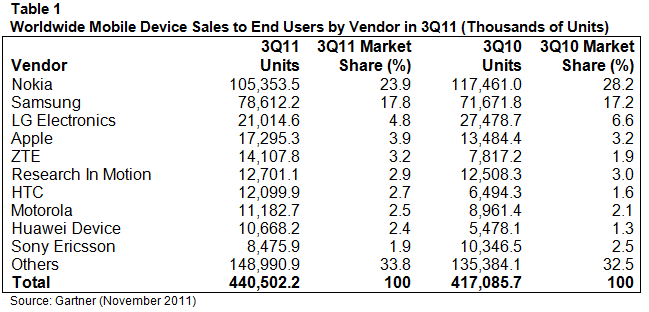
Despite a drop in market share, Nokia continued to be the worldwide leader in mobile device sales, accounting for about 24% of all global sales. The second quarter of 2011 was a low point for Nokia, although the third quarter brought signs of improvement. This is according to research from Gartner.

Dual-SIM phones in particular, and feature phones generally, maintained Nokia’s momentum in emerging markets. Gartner reckons that “heavy marketing from both Nokia and Microsoft” to push the new Lumia devices should bring more improvement in the fourth quarter of 2011. A true turnaround won’t take place, however, until the second half of 2012.

Samsung now the biggest smartphone manufacturer

The second biggest phone manufacturer by sales is Samsung. The company has also now become the number one smartphone manufacturer worldwide as its sales tripled to reach 24-million. Samsung took poll-position as a smartphone manufacturer for the first time, ahead of Nokia in Western Europe and Asia.

Gartner attributes this to the strong performance of Samsung’s Galaxy smartphones, which now cover a broad range of prices, and a weaker competitive market. Analysts expect more competition in the fourth quarter of 2011, not least because sales of the iPhone 4S, 4 and 3GS will capture share from Android manufacturers.

Apple down, but big comeback expected

Apple shipped 17 million iPhones, an annual increase of 21%, but down nearly three-million units from the second quarter of 2011 because of Apple’s new device announcement in October. Gartner believes Apple will bounce back in the fourth quarter because of its strongest ever pre-orders for the iPhone 4S in the first weekend after its announcement.

Markets such as Brazil, Mexico, Russia and China are becoming more important to Apple, representing 16% of overall sales and showing that the iPhone has a place in emerging markets, especially now that the 3GS and 4 have received price cuts.

Android now on more than half of all smartphones

The Android OS accounted for 52.5% of smartphone sales to end users in the third quarter of 2011, more than doubling its market share from the third quarter of 2010.

“Android benefited from more mass-market offerings, a weaker competitive environment and the lack of exciting new products on alternative operating systems such as Windows Phone 7 and RIM,” commented Roberta Cozza, principal research analyst at Gartner.

“Apple’s iOS market share suffered from delayed purchases as consumers waited for the new iPhone. Continued pressure is impacting RIM’s performance, and its smartphone share reached its lowest point so far in the US market, where it dropped to 10%.”

Strong smartphone growth in China, Russia

Smartphone sales to end users reached 115-million units in the third quarter of 2011, up 42% from the third quarter of 2010. Sequentially, smartphone sales slowed to seven percent growth from the second quarter of 2011 to the third quarter of 2011. Smartphone sales accounted for 26% of all mobile phone sales, growing only marginally from 25% in the previous quarter.

“Strong smartphone growth in China and Russia helped increase overall volumes in the quarter, but demand for smartphones stalled in advanced markets such as Western Europe and the US as many users waited for new flagship devices featuring new versions of the key operating systems,” said Cozza. “Slowdowns also occurred in Latin America and the Middle East and Africa.”

440m phones sold worldwide

Worldwide, sales of mobile devices totalled 440.5-million units in the third quarter of 2011, up 5.6% from the same period last year, according to Gartner. Non-smartphone devices performed well, driven by demand in emerging markets for low-cost devices from white-box manufacturers, and for dual-subscriber identity module (SIM) devices.

“Our forecast for the end of the year remains broadly in line at a worldwide level as regions such as Asia/Pacific and the Middle East and Africa make up for weaker performance in the Western European market,” said Annette Zimmermann, a principal analyst at Gartner based in Munich.